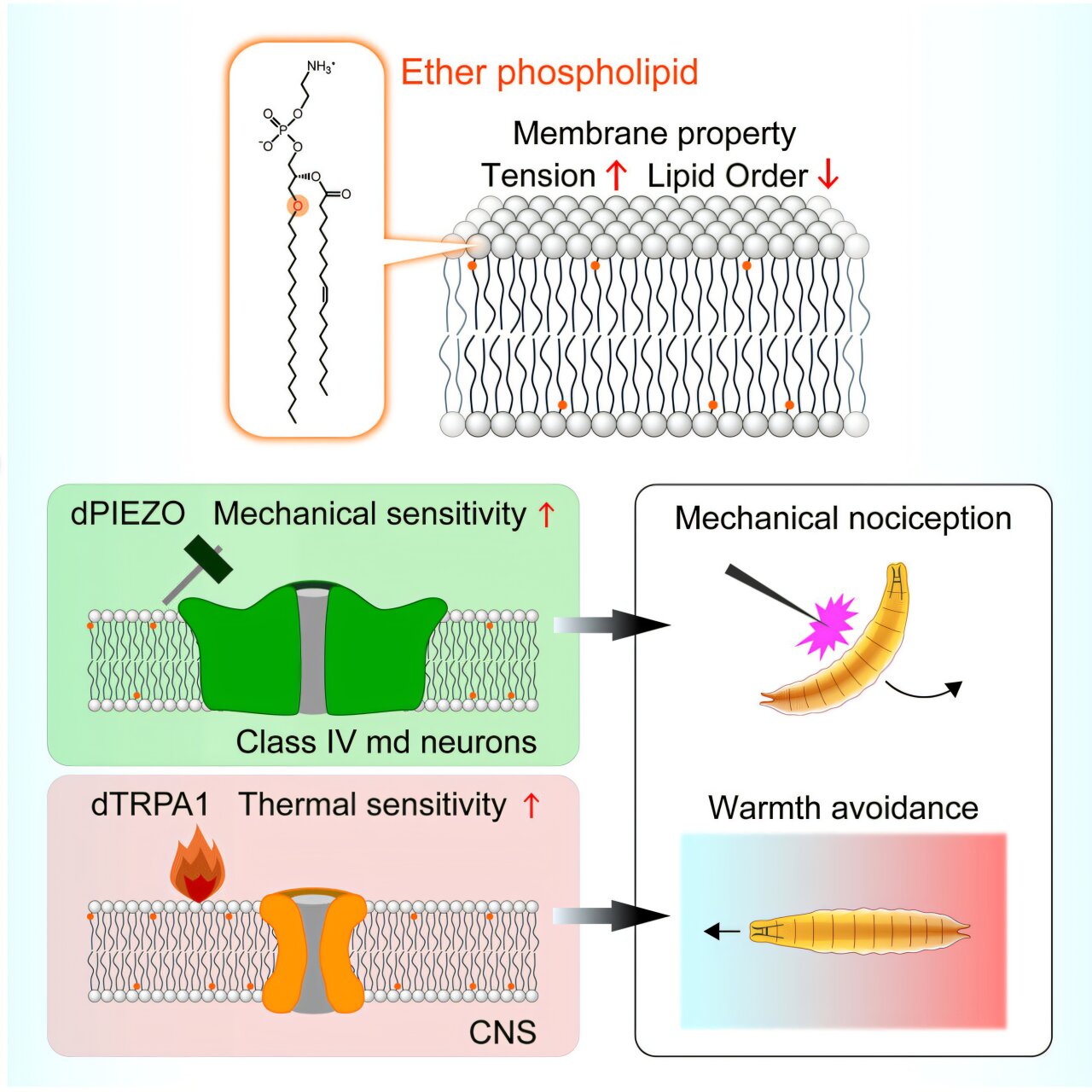
Our ability to feel a harmful touch or sense dangerous heat relies on specialized receptor proteins embedded in nerve cell membranes. But how do these receptors maintain their exquisite sensitivity? In a new study, researchers identified ether phospholipids (ePLs) as key regulators that optimize the function of different sensory receptors, enabling precise responses to mechanical and thermal stimuli in fruit flies—findings with potential implications for human sensory systems. The paper is published in the journal iScience.
Subscribe to our newsletter for the latest sci-tech news updates.
Using the fruit fly Drosophila melanogaster as a model, Takaaki Sokabe and his team at the National Institute for Physiological Sciences (NIPS) /the Exploratory Research Center on Life and Living Systems (ExCELLS) / The Graduate University for Advanced Studies (SOKENDAI) discovered that ePLs—particularly a type called ether phosphatidylethanolamines—are abundantly present in neurons and play a crucial role in somatosensation. When they knocked out AGPS, the enzyme essential for ePL production, flies showed dramatically reduced responses to both mechanical touch and warm temperatures.
“What surprised us was the versatility of these lipids,” says lead author Takuto Suito. “A single class of membrane lipids can simultaneously regulate functionally distinct sensory receptors—the PIEZO channel for touch and the TRPA1 channel for heat.”
Through electrophysiological recordings in cultured cells, the team demonstrated that ePLs directly enhance PIEZO channel sensitivity to mechanical stimuli and lower the temperature threshold for TRPA1 activation by about 2°C. These effects appear to work through changes in membrane physical properties: ePLs increase membrane tension while simultaneously making it more fluid, creating an optimal environment for receptor function.
Unlike other lipids that affect specific receptors through direct molecular interactions, ePLs seem to work by modulating the overall physical properties of cell membranes. Using atomic force microscopy and fluorescent probes, the researchers showed that ePLs alter membrane stiffness and lipid organization—properties that are critical for mechanosensory and thermosensory protein function.
“This reveals a previously unrecognized role for lipids in the nervous system,” Sokabe explains. “Rather than just serving as structural building blocks, these specialized lipids actively tune sensory receptor sensitivity.”
The findings could have broader implications beyond basic neuroscience. ePL levels are reduced in several neurodegenerative diseases, including Alzheimer’s and Parkinson’s disease. Understanding how ePLs regulate sensory proteins could open new therapeutic avenues for maintaining sensory function and potentially treating conditions associated with altered ePL metabolism.
More information: Takuto Suito et al, Ether phospholipids modulate somatosensory responses by tuning multiple receptor functions in Drosophila, iScience (2026). DOI: 10.1016/j.isci.2026.115209
Provided by National Institutes of Natural Sciences
This story was originally published on Medical Xpress.