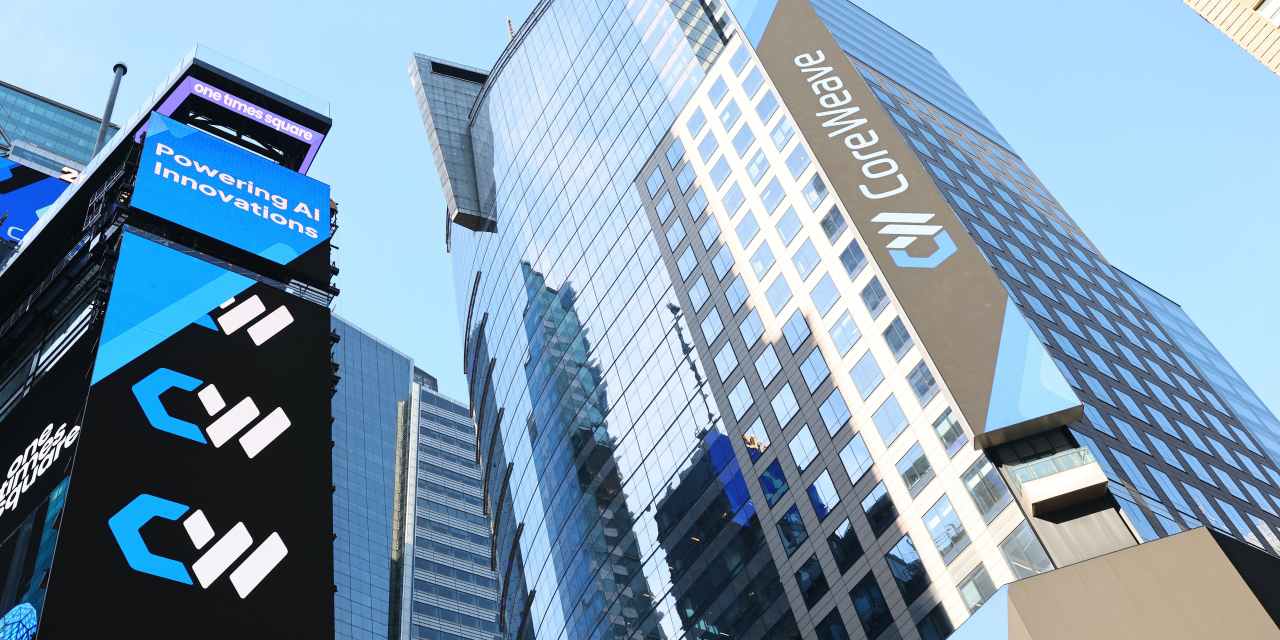
As Big Tech scrambles to build artificial intelligence, demand for compute has far exceeded supply. It’s become a massive business opportunity for neoclouds, or companies that provide AI-infrastructure services.
For BofA Securities, two names in particular are especially compelling. On Tuesday, BofA analyst Tal Liani reinstated coverage on CoreWeave’s stock with a buy rating and a $100 price target, which is 22% above current levels. He also initiated coverage on Nebius shares with a buy rating and a $150 price target, which implies about 31% upside.
Liani sees a solid demand trajectory for the $79 billion AI-infrastructure-as-a-service market, arguing that the rise of agentic AI is accelerating compute needs and extending a supply-demand imbalance that likely won’t ease until 2029. CoreWeave and Nebius’s customers include some of the biggest names in tech, such as Meta Platforms and Microsoft
But neoclouds have also invited controversy, as critics have pointed out potential risks such as customer concentration, heavy capital-expenditure requirements and the sustainability of the business model. As Big Tech brings their own data centers online over the next two years, demand for these infrastructure services could decline.
Read: How CoreWeave’s ‘situationship’ with Big Tech could cause a 30% stock drop
Liani acknowledged that CoreWeave’s long-term success will depend on its ability to “broaden its product set” into areas like managed inference and storage, while increasing higher-margin software contributions. “Hyperscalers will close part of the gap, but the speed and slope of that convergence remain uncertain,” Liani said.
“Even so, the medium‑term setup and execution milestones skew the risk‑reward positively, supporting our buy rating,” Liani added. In the next 12 months, he expects CoreWeave to benefit from new graphics-processing-unit deliveries and data centers, new power capacity and refinancings to lower the company’s cost of capital.
Liani also flagged that CoreWeave is de-risking its balance sheet by financing projects through special-purpose vehicles linked to customers’ credit ratings. That means that lenders will underwrite Meta or Microsoft’s investment-grade credit quality instead of CoreWeave’s non-investment-grade rating. These agreements have “strong contract visibility” and result in “meaningfully lower borrowing costs, as credit risks transfer to the customer,” Liani wrote.
See more: Nebius’s stock falls as investors get a wake-up call on the cost of competing in AI
For Nebius, Liani believes the company’s distributed virtualization layer, which connects GPUs across multiple locations to create a unified cluster, is a “structural long-term differentiator and one of the company’s most defensible advantages.” This capability allows Nebius to meet variable customer demand, increase utilization and support faster deployment cycles.
Nebius is the only AI-compute provider with a “truly global GPU fabric,” Liani highlighted, adding that other neoclouds can only virtualize within a single physical facility. Traditional hyperscalers such as Oracle and Microsoft are “even more limited, as these companies do not currently support GPU-specific orchestration layers,” according to Liani.
While Nebius is earlier in commercial and financial maturity than CoreWeave, the company is in a high-growth phase. Liani projects that revenue will grow 501%, 199% and 64% in the next three years. Last week, Meta announced a $27 billion deal to purchase Nebius’ compute services.
Nebius trades at 3.0 times 2027 sales, significantly lower than the peer-average multiple of 6.4. The valuation makes Nebius undervalued relative to its growth potential, Liani believes. His $150 price target implies a 2027 sales multiple of 4.0, placing Nebius at a slight premium to CoreWeave’s multiple of 3.1.