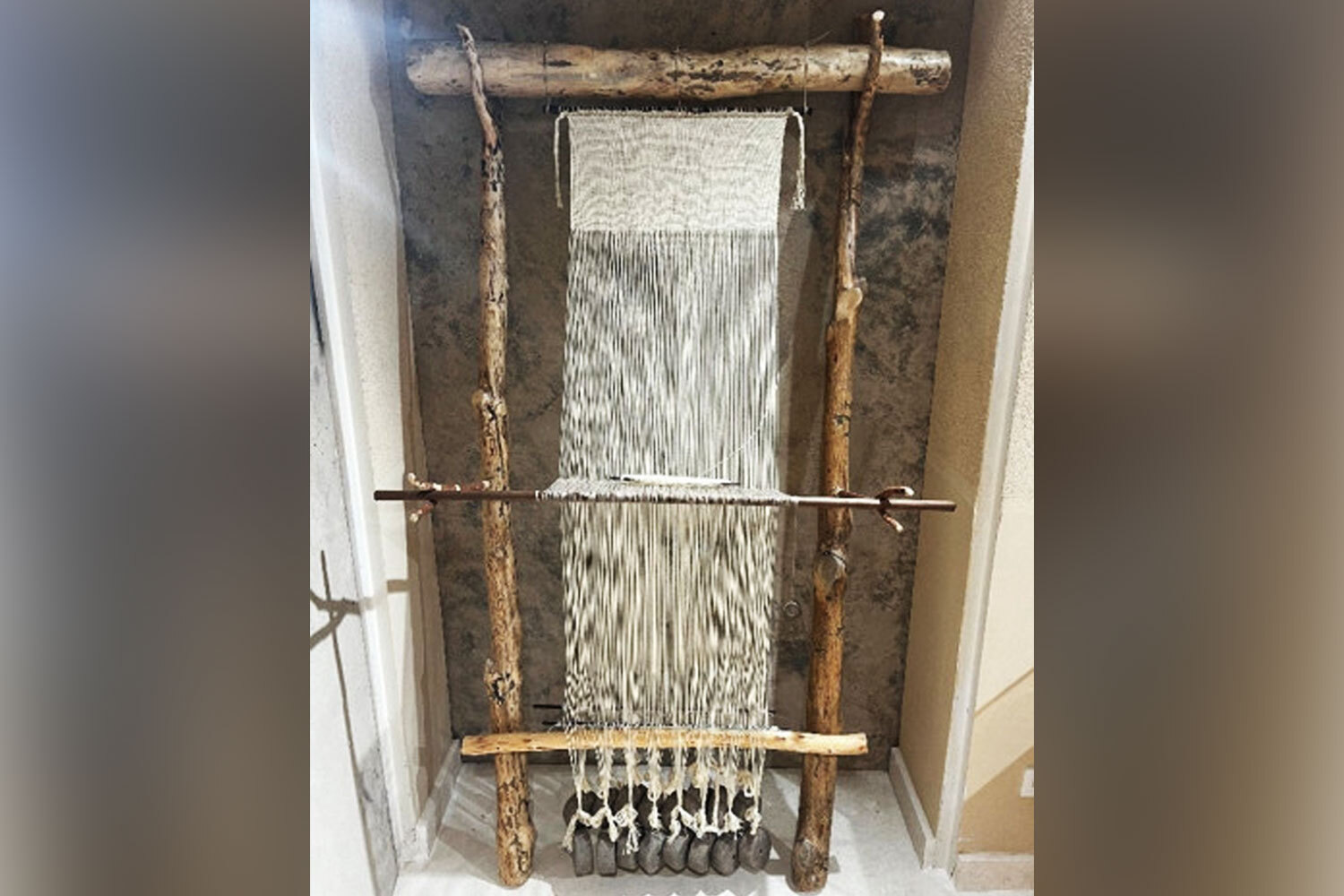
Beneath the remains of roofs collapsed in a long-ago fire in a bustling Iberian settlement, scientists unburied one of the world’s oldest weaving machines.
While historians have long hypothesized about the fashion of early human settlements, clothing samples and textile production technologies are hard to come by in the archaeological record. Made primarily of organic materials, looms and plant fabrics scarcely survive the ravages of time. But, in 2008, researchers discovered the remains of a warp-weighted loom at the Bronze Age Cabezo Redondo archaeological site in Spain. One of the oldest of its kind ever found, this loom is providing new insights into textile practices in the Mediterranean in the second millennium B.C.E.
“To find a loom like this, just as it was standing there 3,500 years ago, is really remarkable,” Karina Grömer, an archaeologist at the Natural History Museum Vienna, tells Science’s Andrew Curry.
A team of scientists from numerous Spanish universities published a revelatory study this month in the journal Antiquity, explaining how exceptional conditions allowed the wooden loom structure and some plant fiber ropes to remain preserved. The study’s findings include evidence of early variation and intricacies in Bronze Age textile practices.
Warp-weighted looms were the predominant weaving tool in western Europe for thousands of years, with evidence of their use dating as far back as 7000 B.C.E. These looms consist of two vertical posts intersected by two horizontal beams, like a ladder. Threads hang from the top beam and are weighted at their bottoms by stone or clay “loom weights” to create tension and keep the fibers hanging parallel while the weaver works them into a cloth from the top down.
The existence of warp-weighted looms in ancient civilizations is typically inferred by the presence of the weights themselves, as the only non-organic material in the loom. Excavated loom weights have provided ample evidence of this warp-weighted loom technology in sites from modern-day Turkey to the British Isles, but until now, researchers have been limited in their ability to create a complete picture of the loom’s presence within a society. When a fire destroyed and buried a collection of buildings in Cabezo Redondo 3,500 years ago, it froze this particular loom in time, providing an unusually complete snapshot of its use in the context of everyday Bronze Age life.
“[This loom] allows us to move beyond interpreting isolated weights to documenting a functioning loom in near-photographic detail, including its wooden structure, ropes, weights, and architectural context,” Ricardo Basso Rial, a researcher at the University of Granada who worked on the discovery, tells Heritage Daily’s Mark Milligan.
Cabezo Redondo, located near modern-day Alicante, Spain, was a thriving and well-connected settlement for a thousand years beginning around 2100 B.C.E. Since excavations began there in 1959, Cabezo Redondo has been considered an important example of Bronze Age culture in the Iberian Peninsula.
Analysis of the carbonized loom remains attributed the wood to the Aleppo pine tree, a species common in the region. Alongside these beams were sturdy grass fibers, likely used to tie the pieces of the frame together. The loom was found in what would have been a common space among several homes. Because the fire preserved the loom in the spot it was last used, researchers can speculate that multiple households may have collaborated on weaving fabrics.
The loom weights, found alongside the frame, also add a new layer to this story of textile work. At just 200 grams, they are much lighter than the 400 to 900 gram weights typical of the region and time. In the paper, Basso Rial proposes that this may indicate the weaving of lighter fibers, such as sheep’s wool, which would have been new in the region. These light weights would have been ineffective for managing the thicker plant fibers common at the time.
“The characteristics of the loom weights suggest that this loom was capable not only of producing open tabby fabrics, but also potentially denser and more technically complex textiles, probably including early twill weaves,” says Basso Rial in a statement on the study.
Researchers outside the study agree that it’s a possibility, but propose wariness in drawing that conclusion too quickly. Margarita Gleba, an archaeologist at the University of Padua who was not involved in the study, tells Science that the lighter weights could indicate that weavers were working with thinner, more delicate strands of the same plant fibers.
Whether weavers at Cabezo Redondo were using new fibers or new techniques for the same fibers, this latest loom discovery illustrates that weaving practices were growing more sophisticated, and the resulting textiles more diverse. It gives researchers a new thread to follow in teasing out the story of textile development in ancient societies.
“[This finding] represents an exceptional laboratory for studying the technical and social evolution of textiles during the second millennium B.C.E,” Basso Rial tells Heritage Daily.
This article was originally published on Smithsonian Magazine. Read the full story here: A Bronze Age Loom Sheds New Light on Mediterranean Textile Practices © 2026 Smithsonian Institution.