WASHINGTON/GREENVILLE, N.C. (WITN) – When Amanda Moore visits her 81-year-old father in the ICU at ECU Health Beaufort Hospital in Washington, she knows he’s getting critical care from more than just the team in the room.
Sometimes, his doctor appears on a screen.
“They just push it in the room and the doctor comes on,” Moore said.
Her father, Horace Carter, is being treated for heart and kidney issues. And while his bedside care team is in Washington, his critical care physician is about 25 miles away in Greenville.
That’s where the Tele-ICU program based at ECU Health is changing how care is delivered across eastern North Carolina.
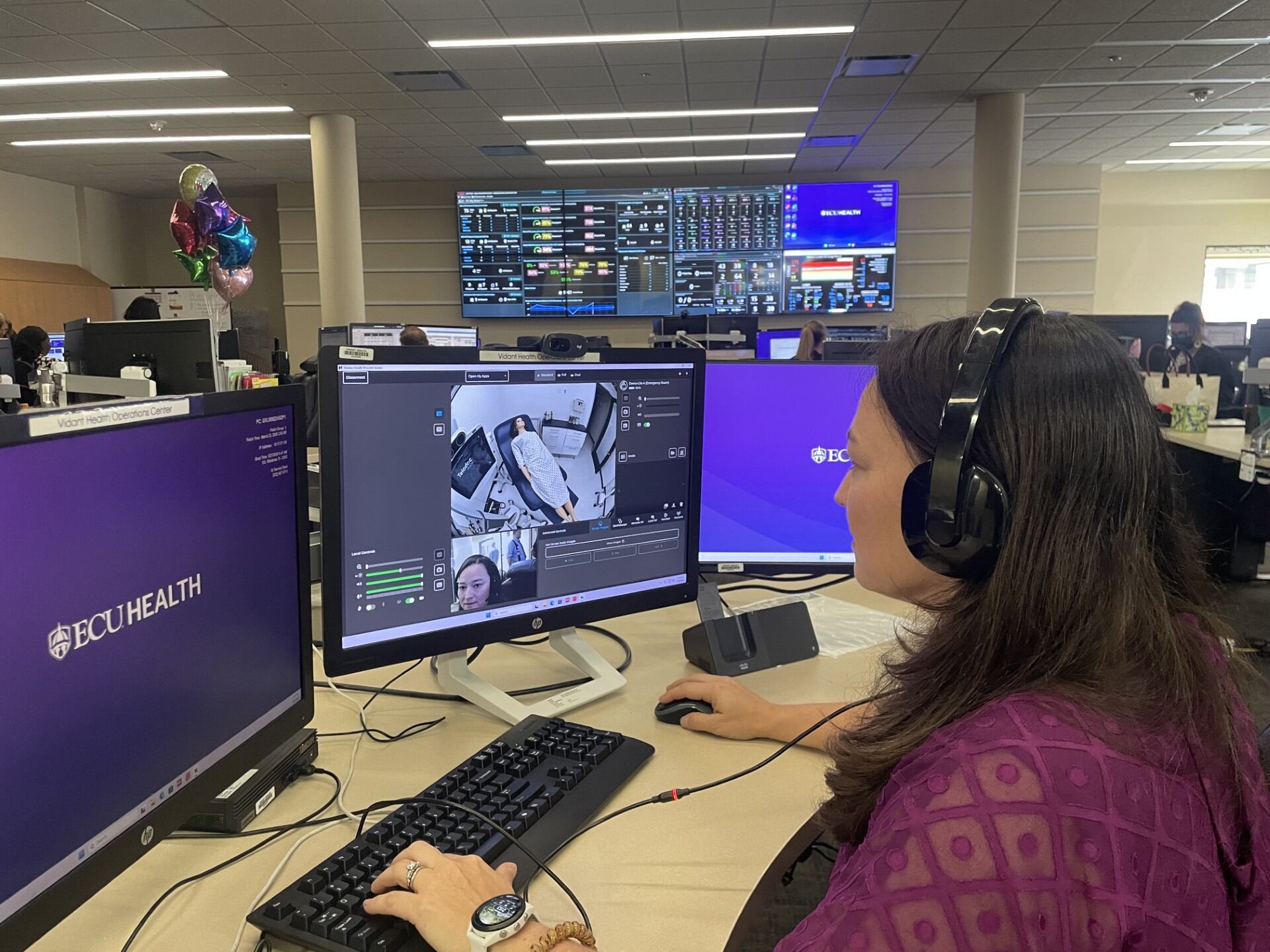
Inside ECU Health Medical Center, a centralized operations hub coordinates care for patients across multiple hospitals in the region. Through video technology, critical care doctors can connect instantly with patients, nurses, and families.
“It allows us to go into a patient’s room virtually,” said Dr. Jennifer Stahl, a Tele-ICU physician.
From miles away, doctors can assess patients, review vital signs, and even help manage life-support equipment.
“These are very sick patients on life support, and so really kind of high-stakes, very sick patients that we’re seeing,” Stahl said.
For families, the biggest impact may be avoiding a transfer.
Moore says, It’s actually good because I spoke with transferring him to Greenville and because he’s not able to be transferred there, they were able to come to us.”
According to ECU Health, about 90 percent of Tele-ICU consultations do not require a transfer, allowing many patients to stay at their local hospital.
That can make a major difference in a largely rural region, where distance often separates patients from specialized care — and from their families.
“It allows those family members and friends to be part of the care, which is so important,” Stahl said.
ECU Health is not alone.
At CarolinaEast Health System in New Bern, hospital leaders are also expanding virtual care — partnering with Access TeleCare to provide 24/7 access to neurologists and psychiatrists.
That’s especially critical for stroke patients, where timing can determine recovery.
“There is a window of opportunity between the onset of symptoms and when recovery from a stroke is limited,” said Chief Medical Officer Dr. Michael Davis.
Hospital leaders say virtual access also helps address staffing challenges. Jim Davis, Chief Nursing Officer, says, “Psychiatrists are difficult to recruit, and to be able to provide that service 24 hours a day, 7 days a week, we now have the assistance of Access TeleCare helping us do that.
Healthcare providers say virtual care could play a growing role in rural communities — bringing specialists to patients instead of moving patients long distances.
For some families, the technology is already making a lasting impression.
“I had one this morning and the patient family member said ‘robot doctor, this is so cool, I love this. This is so neat to see this and be able to interact with you but still stay at our home hospital,’” Stahl recalled.
Moore said, “Being able to be here when needed was an awesome thing for me and my family.”
East of Innovation will be back next month with another report looking at how technology is changing the way we live in eastern Carolina.
Click here to watch February’s report: East of Innovation: How smart agriculture is changing eastern Carolina
Click here to watch January’s report: East of Innovation: Advanced air mobility transforming eastern North Carolina