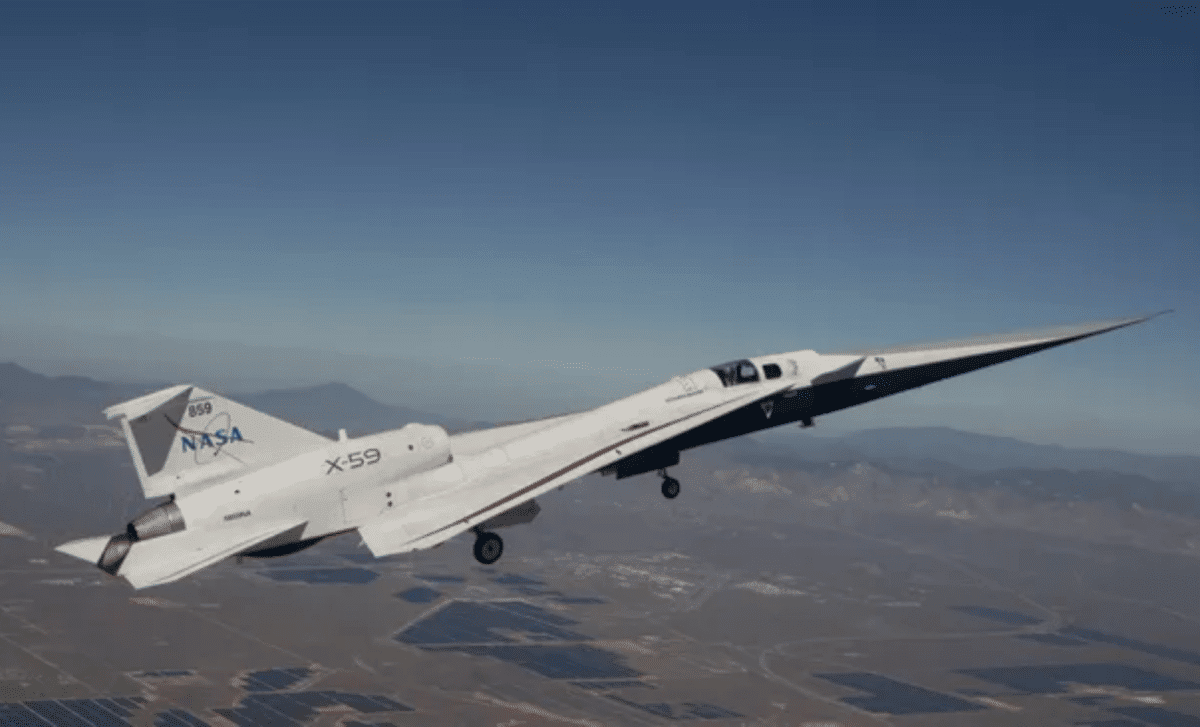
NASA’s experimental X-59 supersonic jet, developed under the Low-Boom Flight Demonstrator program, was forced to end its second-ever test flight early due to a technical glitch, according to NASA. The aircraft, designed to revolutionize supersonic travel by drastically reducing sonic booms, still achieved key objectives despite the interruption, marking another step toward reshaping commercial aviation.
A Promising Flight Interrupted Mid-Air
The second test flight of the X-59began with high expectations as engineers aimed to expand the aircraft’s performance envelope. The jet, built to fly faster than sound while producing only a soft sonic “thump,” represents years of aerodynamic innovation and acoustic modeling. During the mission, systems were closely monitored to validate how the aircraft behaves under real flight conditions.
Partway through the flight, a technical issue triggered an early return. The exact nature of the glitch has not been fully detailed, though NASA confirmed that safety protocols worked as intended. The pilot executed a controlled landing, demonstrating the robustness of both the aircraft’s design and the training behind the mission.
“Despite the early landing, this is a good day for the team. We collected more data, and the pilot landed safely,” said Cathy Bahm, project manager for NASA’s Low-Boom Flight Demonstrator at NASA’s Armstrong Flight Research Center in Edwards, California. “We’re looking forward to getting back to flight as soon as possible.”
Even with the shortened flight, engineers gathered critical telemetry, offering insight into how the aircraft performs in real-world conditions beyond simulations.
Open the Youtube video
Why The X-59 Matters For The Future Of Flight
The X-59 is not just another experimental aircraft. It is central to NASA’s effort to bring back commercial supersonic travel over land, which has been restricted for decades due to the disruptive sonic booms produced by earlier jets like the Concorde.
Instead of a loud boom, the X-59 is engineered to generate a much quieter sonic signature. This is achieved through its elongated nose, carefully shaped fuselage, and innovative aerodynamic profile that spreads shockwaves in a way that reduces noise on the ground.
NASA plans to fly the aircraft over select communities in the future, gathering public feedback on the perceived noise. That data will be shared with regulators such as the Federal Aviation Administration (FAA), potentially paving the way for new rules that could allow commercial supersonic flights over populated areas.
The success of this program could redefine long-distance travel, cutting flight times dramatically while maintaining acceptable noise levels.
A Long Campaign Just Beginning
While the early landing might seem like a setback, NASA teams view it as part of a broader and carefully planned testing campaign. Flight testing is inherently iterative, with each mission contributing to a growing understanding of the aircraft’s performance.
“As we like to say, it was just like the simulator – and that’s what we like to hear,” Less said. “This is just the beginning of a long flight campaign.”
The program will continue with additional flights, gradually increasing complexity and pushing the aircraft closer to its operational limits. Engineers will analyze the data from this flight to refine systems and address the issue that caused the interruption.
Enjoyed this article? Subscribe to our free newsletter for engaging stories, exclusive content, and the latest news.