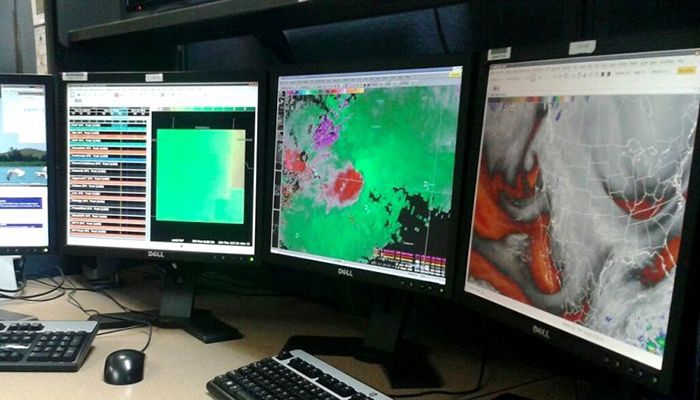
NORTHWEST ARKANSAS, Ark. (KNWA/KFTA) — The National Weather Service (NWS) is planning to move its data and services to a cloud server and develop new tools to replace current applications, which will increase flexibility and scalability for its offices and partners, and allow for the integration of artificial intelligence and public/private data sources.
NWS awarded two contracts to create brand-new tools that will replace the current centralized application used across the government agency. The major replacement in question will be AWIPS (Advanced Weather Interactive Processing System), which is the information technology system NWS uses to integrate meteorological, satellite, hydrological, and radar data all in one.
The new proprietary tools exclusive to NWS will be NWS HIVE and NWS CIRRUS, and they will be developed in two phases.
NWS HIVE (Hydrometeorological Interactive Virtual Environment) will be the central application environment that NWS forecasters use to perform the public-facing tasks of analyzing data, creating weather forecasts, and issuing warnings. The NWS HIVE will be designed to handle current operations and leave room for future enhancements to be added to the HIVE, such as new products.
NWS CIRRUS (Centralized Integrated Real-Time Repository for Unified Services) is the cloud server that will store both NWS-owned and partner data. Current systems have different storage and distribution processes, but this cloud server replacement will bring in a “high-quality foundation” to power future capabilities for NWS.
Future capabilities listed are artificial intelligence and integrating public sector and private industry data sources, old and new. There have been several talks recently about utilizing artificial intelligence and machine learning techniques to improve forecast models. Both NWS Hive and NWS CIRRUS will work together to allow for such advancement to happen, something that is currently limited with AWIPS.
Transferring AWIPS’s current capabilities to the cloud will allow NWS employees to create, visualize, and distribute weather forecasts, as well as warnings and advisories, from numerous locations, including remotely, without having to be present at an office to be able to do so.
Here are other flexibilities NWS listed that will be possible with the new tools:
- Access the system from multiple devices, such as mobile phones and home laptops
- Provide support to other NWS offices on short notice, especially remotely
- All guidance tools and decision supports will be available to NWS partners at their fingertips
Versions of the AWIPS software are currently open for the public to use and download through the Freedom of Information Act (FOIA), but it is unclear if the new system will be publicly available for download after AWIPS dissolves in the future.
What is clear is that the new infrastructure will increase flexibility and scalability for at least 150 offices under NWS, including Weather Forecast Offices (WFOs), River Forecast Center, Central Weather Service Units located within major airport hubs, National Centers, and numerous NWS field offices. The public sector and private industry are also included in the conversation.
The first phase, aiming for completion by early 2027, will focus on storage capabilities, remote viewing of weather/water data, and the issuance of products designated for public view.
The second phase, to be completed in early 2028, will focus on ensuring all capabilities are in place to decommission the legacy AWIPS system.
How this impacts broadcast meteorologists like Your Weather Authority Team is up in the air right now, but we will continue to monitor this advancement as more information is released from the National Weather Service!
Copyright 2026 Nexstar Media, Inc. All rights reserved. This material may not be published, broadcast, rewritten, or redistributed.
For the latest news, weather, sports, and streaming video, head to KNWA FOX24.